 Risen
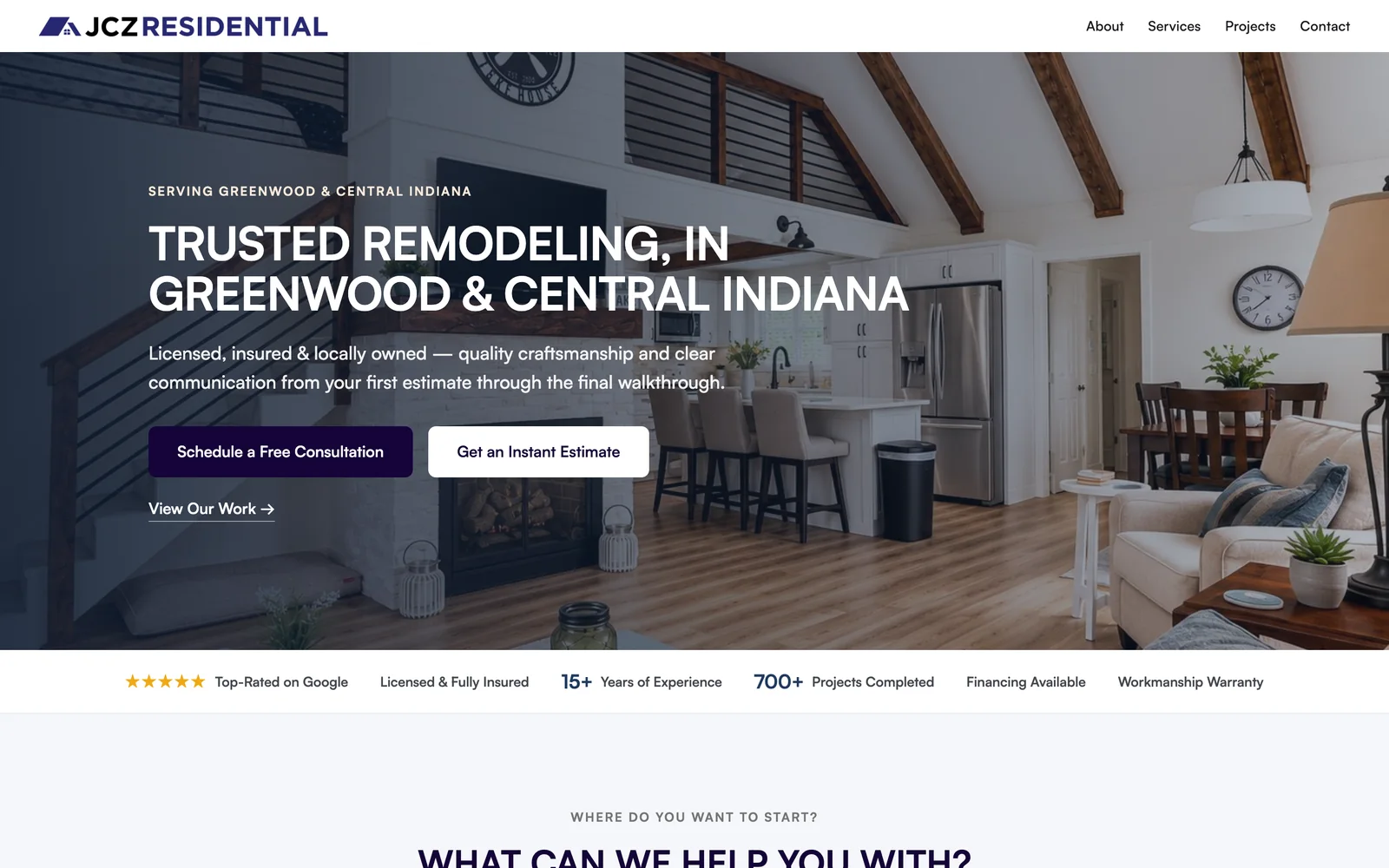
A contractor website should show real photos of finished projects, state licensing and insurance clearly, explain how estimates and contracts work, list the areas you serve, follow federal rules if you advertise financing, and display recent reviews. Risen built and runs the website for JCZ Residential, a remodeling and roofing company in Greenwood, Indiana.
The industry at a glance
The BLS counts 166,900 roofer jobs, with 5% growth projected from 2025 to 2035. About 72% of roofers work for roofing contractors and about 20% are self-employed.[1] Construction managers, the closest BLS category to general contractors and remodelers, hold 609,100 jobs with 9% projected growth, and 38% are self-employed.[2] Many of these are small businesses competing on reputation.
What a contractor website needs
- Real project photos. Before-and-after shots of your own work, labeled with the town and type of job. Stock photos make people suspicious.
- Licensed and insured, in writing. The FTC's advice to homeowners is to consider only contractors who are licensed and insured, and to get a written contract with the contractor's license number.[3] Some states, such as California, require the license number in all advertising.[5]
- How your process works. Free estimate? Inspection? Insurance claims help? Timeline? Explain it, including the three-day cancellation right where it applies.[3]
- Financing, stated correctly. If you advertise payment terms, federal rules require the full disclosures.[4]
- Service area. JCZ lists the eight Central Indiana counties it serves.
- Recent reviews. 31% of consumers will only use businesses rated 4.5 stars or higher.[8]
- Structured data. Use
RoofingContractororGeneralContractor, both specific types underHomeAndConstructionBusiness.[7]
Storm season and your site
After a hailstorm, homeowners search urgently, and storm chasers show up. A local contractor with a real address, real reviews and photos of nearby jobs stands out against them. Make storm-damage inspections easy to request, and keep your hours and phone current through your client portal.
How Risen helps contractors
- A custom site built around your projects, services and service area.
- Hosting, SSL, backups, and new project photos added whenever you send them.
- Google Business Profile setup and FiveStar review requests after every job. Roofers and general contractors are also eligible for Local Services Ads.[6]
- Your website is paid for with an agreed donation to Majesty International, a 501(c)(3). Optional monthly services have set prices.
Common questions
What should a contractor's website say about contracts?
The FTC tells homeowners to get a written contract listing the contractor's name, address, phone and license number, and notes a three-business-day right to cancel when a contract is signed away from the seller's place of business. Explaining your process up front builds trust.
Can I advertise financing?
Yes, but if an ad mentions a monthly payment, number of payments, down payment or finance charge, federal Truth in Lending rules require it to also disclose the down payment, the repayment terms and the APR. This applies to contractors who aren't lenders themselves.
Do I have to put my license number in ads?
It depends on your state. California, for example, requires a contractor's license number in all advertising, including online. Check your state's rules. We show it on every page either way.
Can roofers and general contractors use Local Services Ads?
Yes. Roofers and general contractors are both eligible categories in the U.S.
Sources
- U.S. Bureau of Labor Statistics. Occupational Outlook Handbook: Roofers
- U.S. Bureau of Labor Statistics. Occupational Outlook Handbook: Construction managers
- Federal Trade Commission. How to avoid a home improvement scam. July 2022
- Consumer Financial Protection Bureau. Regulation Z § 1026.24: Advertising
- Contractors State License Board (California). Online marketplace fast facts (PDF)
- Google Local Services Help. Getting started with Local Services Ads (United States)
- schema.org. HomeAndConstructionBusiness
- BrightLocal. Local Consumer Review Survey 2026